
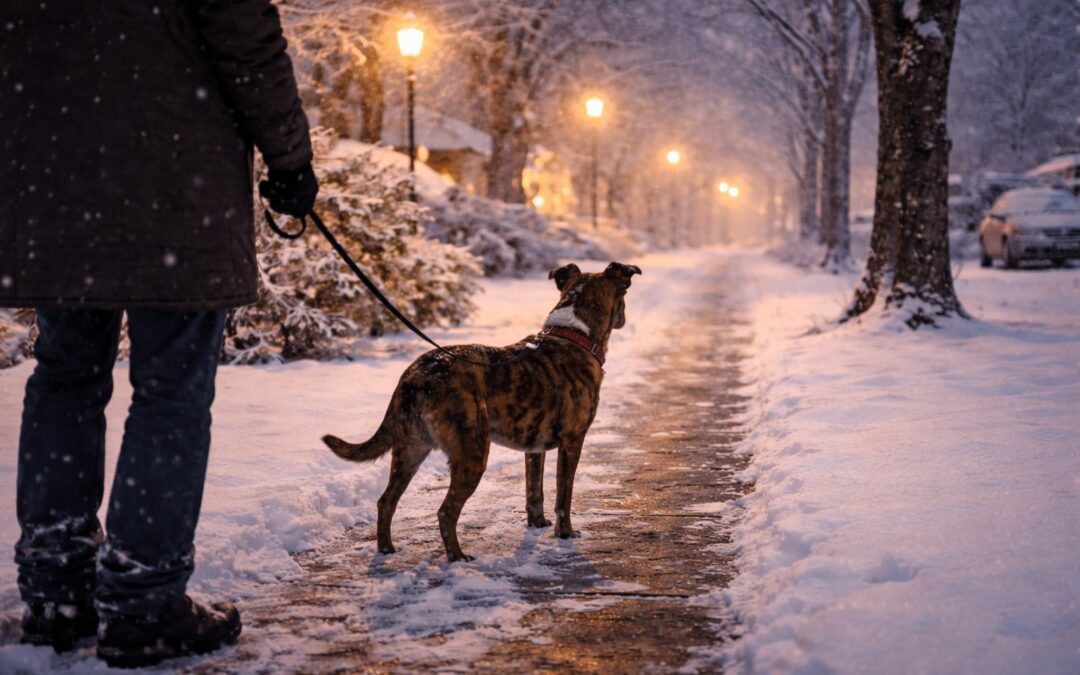
I stepped from the shelter of the inside into the firm hold of the cold. The wind itself was gentle, almost courteous, yet its bite took hold wherever flesh lay bare. I had covered myself carefully, leaving little exposed, but the longer I lingered the more deeply the cold worked its way in, not by force but by patience. It pressed inward as though waiting for consent. The body was left with its familiar choice: to retreat again into comfort, or to move enough that warmth must be made rather than remembered.
I paused there longer than I needed to. Then the leash gave a sharp pull.
My companion had already decided. The snow had fallen recently, and she was eager to be the first to break its surface, nose forward, body taut with expectation. She showed no regard for the cold. If anything, it sharpened her appetite. She tugged hard, as though hoping some threat might emerge from the dark—something she could meet head-on, bark furiously at, and drive away with all the confidence of a creature who has never doubted her right to prevail.
There is no division in the world of dogs. Size offers no instruction. A chihuahua will stand its ground before a shepherd without hesitation, convinced of victory long before consequence arrives. It is less common among people, though I have known a few who carried the same unexamined certainty. As we padded down the street, several came to mind, and with them the quiet suspicion that perhaps we are drawn to animals that echo something already settled within us.
My thoughts wandered easily then.
There was Janis. She could not abide not knowing. Silence unsettled her, and whatever was withheld drew her closer rather than away. A promise, once overheard, took on the weight of obligation, whether it had ever been offered to her or not. I could see her lingering near a doorway, not fully inside, body angled just enough to remain unseen, ears straining toward every sound within reach. She did not listen by accident. She listened by design.
She gathered what she heard greedily, swallowing it whole without pause for understanding. What could not be digested was not discarded. It returned later—regurgitated in company, louder and reshaped, pressed upon others under the guise of concern. Rumor passed through her as food passes through an animal, altered but unmistakable in origin. There was a particular, quiet satisfaction in placing a small, choice detail within her reach and waiting to see how it would surface again, distorted yet familiar. I had no trouble imagining her with a small French bulldog: restless, vigilant, incapable of allowing any movement, sound, or scent to exist without comment.
Then there was Monica. She framed her conclusions early and clung to them fiercely. The world, in her mind, was meant to arrive according to her expectations, and when it failed to do so she met it with offense. Her displeasure announced itself loudly, flung outward at anyone within reach. She backed away only after she was certain her protest had been fully received. How dare they. I saw her clearly as a Pekingese—ornamental, sharp-voiced, perpetually affronted by a reality that refused to center itself upon her.
Dan came next. He was never quick to settle, but neither was he careless. He moved slowly through information, nose down, patient, attentive. He sifted through reports and evaluations without hurry until something caught his attention. Then, without ceremony, he committed himself to it and moved on. I imagined him with the long, pendulous ears of a bloodhound, head low until the scent was found, then lifting suddenly as the path clarified and the way became sure.
And then there was Vanessa.
She arrived already seen. Carefully groomed, meticulously kept, she moved as though the space itself had prepared for her passage. Even the breeze seemed content to linger at her side. She would glance back briefly—not to invite attention, but to confirm it—and her hair would fall again into place, perfectly arranged, as though to say I am here without ever needing to speak it. The higher-ranking males watched her closely, alert for opportunity, eager to meet any need that might present itself in exchange for the smallest acknowledgment. The lesser ones faded, responding only if summoned, and even then uncertain how to proceed. The females held themselves differently—eyes narrowing, mouths tightening, scanning for flaw. Their conversations often began the same way: Who does she think… or I don’t understand how… I saw her without effort as an Afghan hound—elegant, distant, complete, and quietly resented for it.
By then we were nearing the turn toward home.
I looked down at my own companion, faithful still at my side, and felt my mouth lift before I questioned it. I wondered then what others might imagine when they looked at me.
She was a mixed breed. Balanced, in her way. At times easily wounded, though she held it quietly, keeping it close until she was certain it needed to be acknowledged. She was keenly aware of her surroundings, sensing threat before it announced itself. There was pit bull in her making—protective, unyielding, intolerant of cruelty aimed at those she judged weaker or less defended. She was a good presence to have beside me in the dark.
Though she enjoyed the walk, home drew her more strongly still. As we turned toward it, she tugged again at the leash, eager now for the shelter and familiarity waiting inside. Once there, she would settle easily into her place, alert but at rest, content in the security of belonging.
As the door closed behind us, a final thought settled in—quiet, unforced, and precise.
She was not mine at all.
She belonged to my wife.
And I was left to consider, without discomfort and without excuse, what that might suggest about me—and what I had been willing to let walk beside me, believing it said enough.
© 2026 Steven Scott. All Rights Reserved.
Unauthorized use or reproduction of this material is prohibited without written permission.