
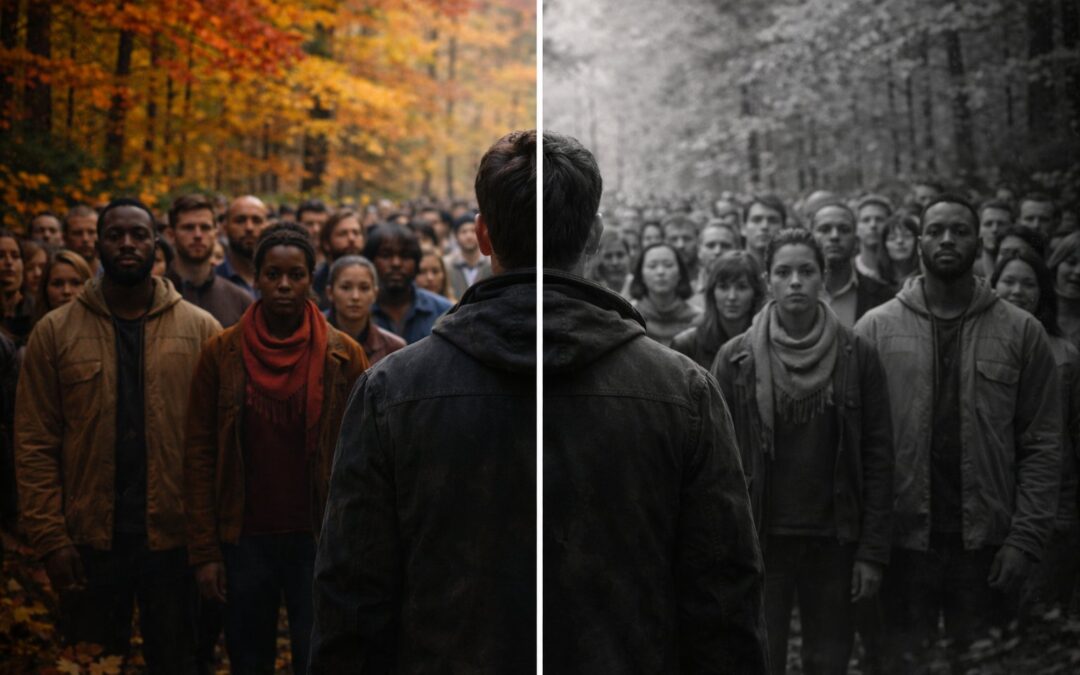
I walked the West Fork trail as autumn stood in its fullness. The forest was layered with color—gold pressed against yellow, red resting beside brown—each holding its place in quiet contrast to the winter that waited beyond them. Soon the leaves would loosen their hold, one by one, and make their way to the forest floor, remaining only briefly before they were drawn down and folded back into the surface from which they came. Nothing hurried them. Nothing resisted the order that carried them.
As I walked, a thought rose without urgency. I wondered what such a scene would appear to one who could not see color. If the forest were reduced to a single tone, if all difference were flattened into sameness, what would remain of its beauty? And from there my thoughts turned outward—to people, to crowds—and I asked what they might appear to the eye if color were absent there as well. If skin bore no variation. If black, white, brown, and all between were gathered into one indistinguishable shade, what judgments would fall away simply because they could no longer find a surface on which to rest.
The thought carried with it an unexpected sense of loss.
Some would disagree. There are those who believe that removing distinction is the same as restoring justice. Yet standing among the trees, I felt otherwise. There is beauty in color, and not one hue stands alone. Each complements the whole. Each carries its own history, its own shape of tradition and character, and together they form a presence richer than any single tone could offer. When allowed to remain within the frame, the landscape becomes fuller, not divided.
To remove such difference by our own hand is not neutrality; it is diminishment. To press any one part lower because of assumption or fear is not order; it is a failure of intent. Such acts do not rise from necessity, but from something smaller, something willing to trade beauty for control. When this occurs, the ground begins to slope toward darker ends, and what is lost is not only justice, but sight itself.
Walking on, the resolve came quietly.
Prejudice does not arise from color. Color is not the wound; it is the gift. It is what gives the world its depth and its resonance. Equality, then, cannot mean reducing all things to sameness. It means granting equal regard. It means standing before the landscape—whether forest or humanity—and allowing every part its place without erasure, without elevation, without dismissal.
To walk among the trees in autumn is to understand this without effort. Nothing is removed to improve the view. Nothing is asked to fade early for the sake of balance. Each is allowed to stand, and in standing, the whole is made complete.
© 2026 Steven Scott. All Rights Reserved.
Unauthorized use or reproduction of this material is prohibited without written permission.