
My blood knows where it belongs, as if it were a thread drawn from an older loom and left, for a long while, to wander—still tethered, still remembering the hand that first measured it. It knows ancestral land. It knows the weight of it. And when that knowing stirs, it does not arrive as thought, nor as a decision shaped cleanly in the mind, but as a pressure beneath the ribs, a quiet pulse that returns again and again, asking nothing, yielding nothing, until the body begins—almost without consent—to turn toward it.
I walk slowly along the emerald coast, and the air is wet with salt and green, the wind carrying the sea’s breath over stone. The longing I carry does not announce itself. It does not rush. It settles. It rests beneath the surface, patient as memory, faithful in its return. The Welsh have named it Hiraeth, and the word does not explain the pull so much as acknowledge it. It stands like a marker set beside the path—useful not because it tells where one must go, but because it confirms that others have felt this same bend in the way.
Sight does not give me what I am after. It gathers only the outer skin of things—the shape of distance, the line of horizon. So I close my eyes, and the world does not recede; it draws nearer. The sea grows louder. The wind takes on weight. The pulse beneath the ribs steadies and deepens. In that narrowing, something aligns—threads tightening, roots pressing downward, a pattern drawing itself into place—until what lies beneath what the eye can hold becomes, for a moment, unmistakable.
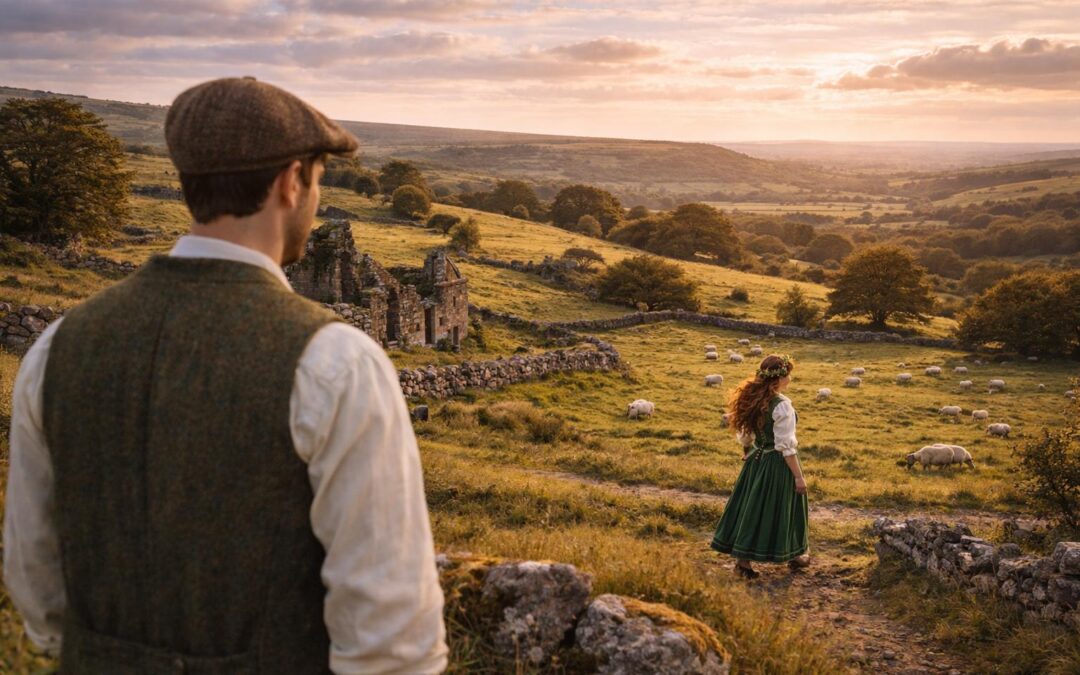
The hills lie open there, rolling gently into one another, not dramatic, not asking to be witnessed, but enduring—like something that has learned how to remain without display. Sheep move across the slopes, careful as water, and native red deer pass in their own order, their presence neither imposed nor accidental. The land carries them as though it expected them. The grass has been shaped by mouths and hooves for so long that the work no longer shows as work. Nothing there seems unfinished. The ground rests in its own measure, set deep upon stone, held fast by roots that do not trouble themselves with being seen.
Small villages sit among the hills, scattered where the land permits gathering. Once they were the dwelling places of kings, and though the crowns have long since fallen silent, the place has not released them. Palaces remain. Walls keep their posture. Stone endures weather without complaint. Memory does not declare itself here; it settles—into seams, into shadow, into the slow darkening left by rain and moss. The land does not hurry forgetting.
I linger where people gather and speak easily with those who have for generations called this place home. Time shows itself openly upon their faces—not as burden, but as something borne and earned. Their hands move with familiarity. Their voices do not press. Silence is allowed its span. They speak of history as one speaks of soil or weather—not as possession, not as performance, but as something received and therefore entrusted. Their words arrive with breath and are given room to settle. This land has been listening longer than any voice now shaped by it, and the people speak as though they sense that listening, whether they name it or not.
It is not longing alone that calls me there. Nor pride. Nor curiosity dressed in reverence. It is recognition—like touching a thread in the dark and knowing it has been tied to you for longer than you remember. As though something in me was formed with that ground already in mind. As though a measure within me was set there before I learned to ask what measure meant. To go there feels less like discovery than return, less like arrival than remembering. The distance between us does not resolve into miles alone. It gathers in time, and time here does not behave cleanly. It folds, presses, loosens—so that what is far draws near, and what has never been touched carries the weight of having been known.
And yet there is an honesty I cannot set aside.
My feet have never pressed that grass. My hands have not touched the stones resting near the lochs. The air of that place has not yet filled my lungs. I have never stood there and felt the wind make its own decisions against my face. Where I reside, breath carries a different weight. The days hold fast. Obligation answers obligation. The body remains where it has been placed, even as something within it leans elsewhere.
I have had visitation only in thought—carried by story, by inheritance, by the quiet persistence of blood that does not forget. I have gone there by listening. By imagining. By allowing the mind to walk paths the body has not yet been given. My purse is small. The world places its limits where it wills. For now, I remain held at the edge of what is desired, living near the seam without crossing it, learning the cost of patience not as absence, but as weight borne over time.
Perhaps one day my bare feet will meet that ground and draw warmth from the limestone resting deep beneath the grass. Perhaps one day what is now known only inwardly will answer the wind and the soil and the smell of the sea carried along its coast, and stone will give its cold and then release it slowly into the palm. Until then, the place remains with me—not visited, yet familiar; not reached, yet present—waiting with the patience such places keep, as though it has already learned how to remain.
For blood carries weight.
And presence is not only a matter of standing somewhere.
It is alignment—
the slow, steady drawing of threads toward the place they were first set to hold.
© 2026 Steven Scott. All Rights Reserved.
Unauthorized use or reproduction of this material is prohibited without written permission.