
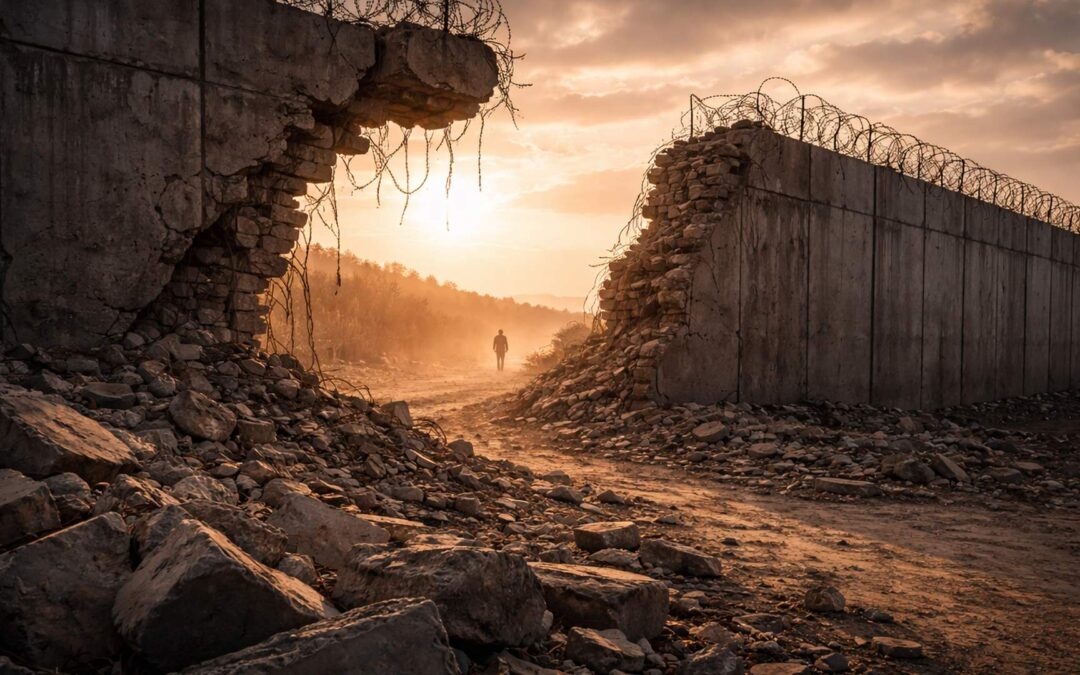
Walls are often raised with confidence.
Stone stacked upon stone, steel drawn skyward—each layer offered as assurance. They promise order. Protection. Control. The language surrounding them is always firm, always certain. A boundary, we are told, is strength made visible.
History does not agree.
Empires have tried this before. Dynasties rose and hardened their borders—Qin, Han, Ming—each convinced that permanence could be built through force and enclosure. Thousands were buried beneath the weight of those ambitions, their lives pressed into foundations meant to last longer than memory. The walls endured for a time. The fear did not. Control never followed as promised.
Walls don’t work.
In another age, concrete divided a city. It cut streets in half. Families. Futures. It was named protection, though what it truly contained were those deemed inconvenient to lose. The brightest minds, the strongest backs, the ones who might have asked difficult questions. The wall was said to keep danger out. In truth, it kept hope in. Disease spread. Trust collapsed. Tyranny did not need to announce itself—it had already been built.
Walls don’t work.
They rise again in different forms—stretching across deserts, framed by language carefully chosen to sound wise. Crime. Security. Order. Plans spoken as inevitability. Groups reduced to names that flatten them. People counted not as neighbors, but as problems. Children separated. Families thinned into numbers. Compassion reframed as weakness. Shame grows quietly behind the structure meant to hide it.
Walls don’t work.
They promise stability while draining the very resources required to sustain a society—time, attention, care. They harden resolve while softening conscience. They demand sacrifice without admitting cost. And as they rise, something else begins to crumble: memory. We forget how often walls have failed. How quickly they become monuments not to safety, but to fear left unchecked.
We forget because forgetting is convenient.
Yet walls never last.
They crack.
They are climbed.
They are dismantled—sometimes slowly, sometimes all at once. And when they fall, what remains is never the order that was promised, but the reckoning that was delayed.
Walls do not solve what they are meant to contain. They only postpone the work that must be done without them.
Walls don’t work.
© 2026 Steven Scott. All Rights Reserved.
Unauthorized use or reproduction of this material is prohibited without written permission.