
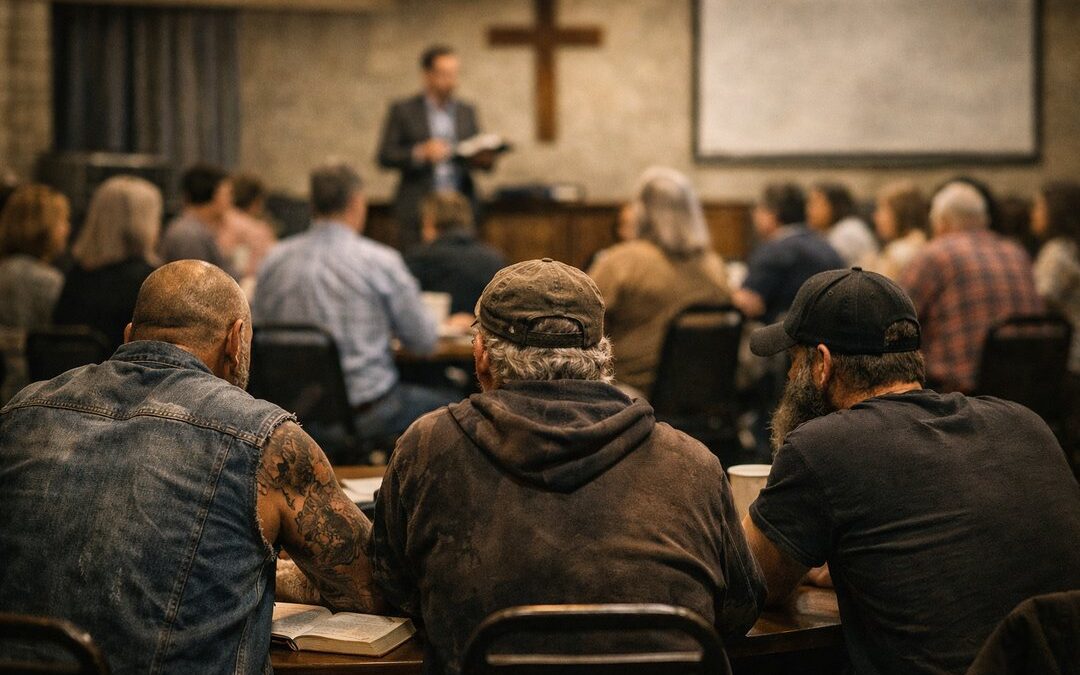
Disguised, I walked into a Bible study at a local congregation and slipped quietly to the back of the room. I sat at the last table, among those who had learned where they were least likely to be noticed. As others arrived, the space filled easily. Greetings passed without effort. Old friendships resumed their familiar rhythms. Hugs were exchanged. Chairs were drawn close to what was already known.
No one moved toward the back.
From the front, the room appeared whole. Most were dressed in similar ways, carrying a shared appearance that required no explanation. Their sameness formed an unspoken language—one that signaled belonging without needing to be named. It marked who was expected, who was recognized, who could enter the space without first proving they deserved to be there.
The back table spoke differently.
The men seated there looked rough, hardened by lives that had not smoothed easily. Their edges were visible—etched into posture, skin, and silence. They did not resemble the room, and the room did not resemble them. Long before a word was spoken, an identity had already been assigned. It hung in the air, quiet but decisive.
The teaching began. It was clear. Faithful. True. And the words themselves traveled the length of the room without resistance. They reached the back table.
The people did not.
When the lesson paused and each table was asked to share and pray together, the room subtly contracted. At the front, conversation came quickly, layered with familiarity. At the back, there was hesitation—not because nothing needed saying, but because too much had already been left unsaid elsewhere.
I began asking questions, gently, without urgency. At first the answers were guarded, shaped by caution rather than openness. Some admitted they were unsure why they continued to come. They had tried, once, to move forward. Tried to introduce themselves. Tried to linger after meetings. Tried to be known. Each attempt had ended the same way—with polite distance, unanswered gestures, or silence that required interpretation. Over time, trying had become costly. Eventually, they learned to stop.
Their lives were messy, complicated, marked by decisions that did not resolve neatly. They were not searching for approval. They were searching for assurance—that their presence was not a problem to be managed, that their nearness did not require permission. What weighed on them most was not rejection, but invisibility.
One man, heavily tattooed, spoke of arriving with his family and being asked to move their car because the space they had chosen was reserved for regular attenders. Nothing unkind was said, yet the boundary had been drawn clearly enough. Another spoke of standing on the edge of despair, of asking for help, of leaving messages that were never returned. Silence, repeated often enough, becomes its own answer.
As they spoke, I found myself watching the front of the room differently. The people seated there were not cruel. They were established. Rooted. Surrounded by what was familiar. Their fear was quieter, but no less real—a fear of leaving what was secure, of crossing a distance that felt unnecessary, of unsettling what already worked.
And so the room had arranged itself without discussion.
Those at the front, hesitant to move back.
Those at the back, no longer believing it mattered to try.
When I asked why they kept returning, the answer came without rehearsal. They knew they did not belong—but they believed God wanted them there. Whatever the room failed to offer, they trusted He would not. His Word, at least, had never turned them away.
I told them not to worry. I told them not to carry the weight of a space that had forgotten how to see. Even if others remained where they were, Jesus would not. I spoke of how God looks past polish and sameness, past what is already arranged, and sees clearly those seated quietly at the edge—still listening, still hoping, even after hope has learned restraint.
As I spoke, the truth settled back onto me.
I had once sat at the front of other rooms. At tables shaped by comfort and recognition. I had known, even then, that I should have stood. That I should have crossed the distance. That I should have gone to the back.
Some divisions are not made by doctrine or belief,
but by fear left unnamed at the front,
and resignation learned quietly at the back.
© 2025 Steven Scott. All Rights Reserved.
Unauthorized use or reproduction of this material is prohibited without written permission.