
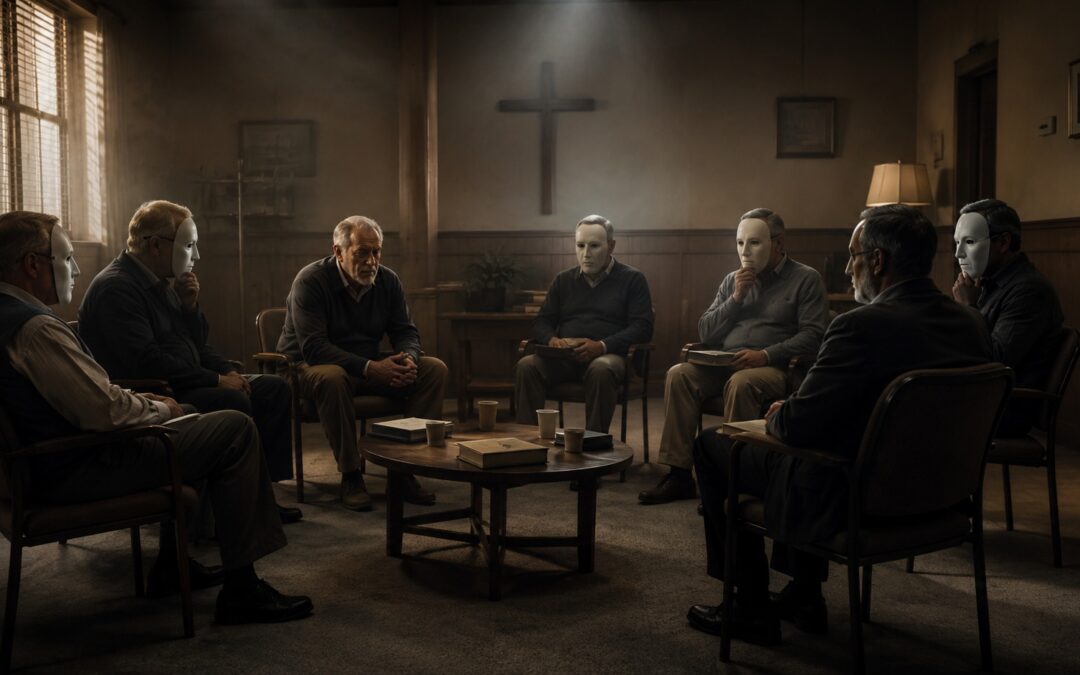
Long before we entered, something had already taken its seat there.
It had known the room before we arrived: the grain of the table, the worn places of the chairs, the careful hush that settles when men come prepared to bear the troubles of others and leave their own outside the door. It dwelt there not as stranger, nor as guest, but as one having long held dominion over the air. We did not summon it. We crossed into its keeping.
Its name was Fine.
And before any man rightly belonged to that circle, he took up the mask.
Not by hand, nor with any open ceremony, yet there was ceremony in it all the same. Each man, entering, seemed to lay aside the uncovered face with which he had crossed the day, and take upon himself the countenance required of the room. The look was graven and familiar: composed, measured, serviceable, bearing enough concern to appear tender, yet not so much openness that his own life might be seen beneath it. It was the sign of entry, the quiet token by which one was permitted to sit among elders and speak of burdens without becoming one.
Into that keeping we came week by week, seven men set as elders over a flock, and I among them, though we entered as men who believed ourselves gathered for counsel rather than summoned beneath a rule already waiting. The matters of the flock were carried in with us: prayers asked, praises given, griefs borne in the lowered voice of another, names laid gently upon the table, and the points of business by which care is made to take visible form. These things were received readily enough, for they belonged, or seemed to belong, beyond the men seated in the circle. They could be weighed, spoken over, prayed upon, and passed from hand to hand without requiring the mask to loosen.
Fine had no quarrel with such things.
It suffered the griefs of the flock to be carried in. A widow’s sorrow could be laid before us. A family’s trouble could be weighed. A child wandering, a marriage strained, a man fallen low beneath some private burden—these could be spoken of with grave faces and lowered voices. Indeed, Fine seemed almost useful then. It lent order to concern. It gave the room its solemn shape. It allowed sorrow to be handled so long as sorrow remained at the proper distance.
Therein lay the rite.
To enter was to cover.
To sit was to appear sound.
To speak was to speak as one who tended wounds, not as one who bore them.
Thus we could pray over another man’s breaking whilst keeping our own fracture veiled. We could counsel grief when grief sat elsewhere. We could speak of burdens, provided the burden did not rise from the chair beside us and ask to be known in flesh.
Then the head elder asked concerning personal life, and marriage, and the inward state of the men seated there.
The question wore the appearance of welcome.
It seemed, for a moment, that truth had been invited nearer than usual, that the room itself had opened some deeper door and was willing to hear not merely of the flock, but of the shepherds. Yet Fine stood behind the invitation like an old keeper of the threshold. It did not forbid answer. It only required the proper garment.
Speak, but do not come uncovered.
Confess, but not in such wise that the room must lay aside its order and become mercy.
Let the answer be living only enough to seem honest, and dead enough to be safely received.
So the words came forth as the room desired them.
All was well.
Everything was fine.
Each man gave his answer in turn, and each answer came clothed before it entered the room. One spoke of home, and the mask held. Another spoke of marriage, and the mask held. Another spoke of his own walk, and still the mask held. The details offered were good enough, positive enough, shaped enough. No burden crossed the circle in its own form. No silence was required to deepen. No prayer was interrupted by need. Fine remained seated among us, pleased by the order of its house.
Yet I knew something of those men.
Not all, for no man is given the whole inward country of another, but enough. I had seen faces before they gathered themselves back into place. I had heard strain beneath common speech. I had known of weather in homes reported fair, and of burdens carried beneath countenances graven smooth by office. The word fine had not healed them. It had only taught them how to be present without being seen.
Then my appointed time arrived.
And not everything had been fine.
The expected word lay near enough. I could have taken it up and passed it onward as the others had done. The mask was there, waiting. It would have fit easily, for I too had worn it before. I could have said all was well, and the room would have kept its shape. No face would have altered. No one would have needed to cross the distance between chair and chair. No mercy would have been required to become more than language.
But the question had been asked.
That was what held me.
Had no question been given, perhaps silence might have remained where it was. But the door had been opened by the asking, or so I believed. Truth had been called toward the threshold, and I thought, in that moment, that it was meant to enter. So I did not speak as one rebelling against the order of the room, nor as one wishing to make spectacle of sorrow. I spoke because I believed honesty had been welcomed.
I shared some struggle. I spoke of the truth of my own life as it then stood, unfinished and not yet made clean by resolution. I did not dress it as victory. I did not turn it into a lesson ready for use. I brought it as it was, still bearing ache, still bearing weight, still alive enough to require more than the word fine could hold.
And the room drew back without moving.
Fine did not rage. It did not need to.
The head elder said my response was unexpected.
There it was.
Not merely surprise, but the hidden law given speech. He had expected, he said, that I would fall in line with the others and say all was fine. After all, that was the expectation for one in the position of elder. The words did not strike loudly, yet they settled with weight. They revealed what the question had truly allowed. Truth had been invited only so long as it came masked. Honesty had been welcomed only if it did not disturb the rule already abiding there.
No prayer followed.
No hand moved across the space between us.
No wisdom rose from among the men, not even slowly.
There was silence, but not the kind that kneels beside pain and keeps watch with it. This was a thinner silence, a waiting silence, the silence of a room hoping the uncovered thing would cover itself again. I looked round the circle and saw the masks still fixed upon their faces. Not cruel faces. Cruelty would have been easier to name. These were men who had asked after life and did not know where to place it when life answered without its covering.
Then the question passed from me to the next elder.
He answered as the room knew how to receive. His words were calm, properly shaped, and in them all was well enough that no one was required to linger. The mask held, and with it the circle seemed to regain its breath.
Then on to the next matter.
The regular course of the meeting returned: another concern named, another report offered, another safe burden allowed its place. The order settled back upon us with such ease that it seemed never to have been threatened, and that ease, more than rebuke, revealed the strength of Fine’s dominion.
Afterward the old word resumed its course.
Everything was fine.
All was well.
Fine had not entered the room that evening. It had been there before us, waiting in the walls, keeping its place, teaching each man what face must be worn to belong. And I began to understand that a mask is not always taken up because a man desires falsehood. Sometimes it is worn because the room has made it the price of entry, and truth, though summoned by question, is welcomed only until it asks the gathered men to become what they had long spoken of being.
© 2026 Steven Scott. All Rights Reserved.
Unauthorized use or reproduction of this material is prohibited without written permission.