
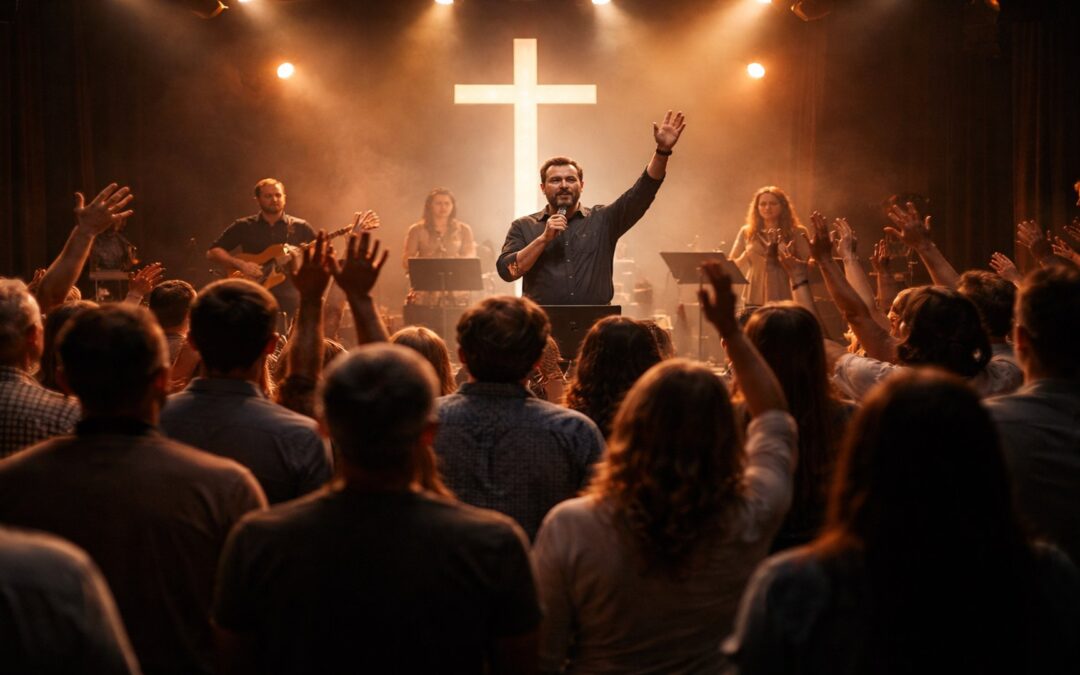
A room full of smiles, and all appears as though it were well, nothing beneath the surface seeming to have shifted or come undone, and they have gathered, it would seem, to touch upon something called divine, though what is named is not always what is given, nor what is given abides.
Music is set in motion—measured, deliberate—the low bass striking deep, not merely to be heard but to be felt, pressing inward upon the body as though something might awaken there if one would yield to it; and so they smile—wide, practiced, unbroken—not because joy has truly found them, but because it has been set before them, quietly, that it should be so.
If one is able—if one is willing—it is not difficult to become as the others, to mirror and to echo, to soften the edges of the self until what remains is acceptable, until what remains, in time, comes to belong.
Yet there are words—slight at first—turned just enough from their truer shape that they no longer point where once they did, and images—distorted, sharpened where they ought not be—are brought forth, not to heal but to hold, so that hurting souls become the ground upon which these things move, and the wounded, already bent low, are made to bear more.
One stands in authority—so it is declared—and from that place he speaks, not always with cruelty, yet not without a certain narrowing of the way; he measures, he weighs, he names those who have not chosen as he has chosen, and calls his choosing the way, as though no other path had ever been set before the feet of men.
There are promises given—softly, often quietly—promises of fixing, of easing, of relief that may be found if only a hand is raised when no eye is upon it, if only one would step—however slightly—into what is set before them.
And some do, not from folly alone but from hunger, for hope has been scarce, and even a fragment, loosely cast, may seem as bread to the starving, and so they reach—not always knowing what it is they take hold of—only that it bears the likeness of what they have long desired.
Yet truth—whole and unbroken—has not been laid before this gathering; it has not been spoken in its fullness, nor allowed to remain among them, and the thorn of true faith—sharp, refining, and costly—has been withheld, as though it were something to be feared, rather than something through which one must pass.
For the way, when it is true, does not promise ease where there is none, nor mend all things at once, nor lift every burden from the shoulders of the weary; there is cost, and there is weight, and life does not untangle itself simply because one has asked it to, but may yet press harder—like broken stone laid upon the back—until the soul learns not how to escape it, but how to stand beneath it.
And those once near—friends, kin, familiar voices—may not remain, but may turn aside, not always in malice, but because they do not walk where you must now walk, and the path may narrow further still, its stones less certain beneath the foot, its end less visible to the eye.
Dreams—once held close—may need to be loosened from the grasp, and things once called precious may need to be set aside, not because they were without value, but because they cannot be carried where this road is leading.
And yet it is not without promise.
There is, indeed, a reward—though it does not arrive as it is often described, for it is not found in the absence of struggle, but within it, not in the surrender to ease, but in the quiet, enduring refusal to yield where one must stand.
To receive Him—truly receive—is to step toward an ending that is better, though the path that leads to it cannot be softened into something it is not; it must not be dressed in comfort, nor spoken of as though it asks little, for what is given freely was not without cost.
And what is entered must be entered in truth—not through the gentling of words, nor through the shaping of appearances, but as it is:
narrow,
weight-bearing,
and wholly real.
© 2026 Steven Scott. All Rights Reserved.
Unauthorized use or reproduction of this material is prohibited without written permission