
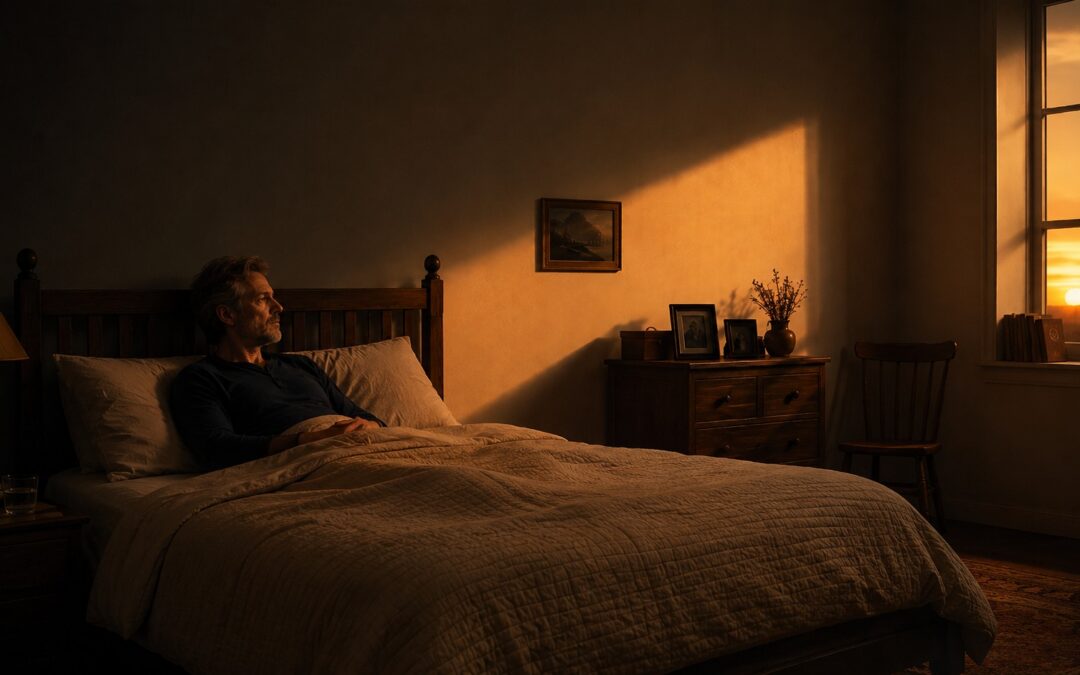
Reclining a little before at last I laid my head upon the pillow, I watched the night take possession of the room.
It did not come in haste. It had no need. The shadows lengthened first along the wall, then drew themselves softly across the floor, as though some slight and unseen breath had swept the sun farther along its appointed course and left the room to what followed after. Light withdrew by measure. Edges loosened. Familiar things, which a short while before had stood plainly in their places, began to yield their certainty, not because they had moved, but because another presence had begun to clothe them.
Its name was Shadow.
It was not merely darkness, nor the absence of what had been. It had its own patience. It entered no room as a thief would enter, breaking lock and hinge, but as one who had always known he would be received when the hour was come. Behind it, clear things lost their first face. A chair became a shape. A table became a weight in the corner. The walls, which had held the day without question, seemed now to draw inward, keeping counsel with what could no longer be seen.
And there, in that quiet taking, I began to consider how a life is overtaken in much the same way.
At the beginning, there is light enough to spend without counting. The path ahead appears open, filled with places not yet discovered, rooms not yet entered, names not yet known, and the soul moves forward because forward seems the natural country of its own becoming. The sun rests upon the road before us, and what lies ahead, though unknown, is touched with brightness enough that we call it promise.
But behind us another work has already begun.
What has been lived does not remain in the light by which it first appeared. It passes, little by little, into the keeping of Shadow. There it is not destroyed, yet neither is it preserved entire. Memory gathers it, but memory is no faithful glass. It softens some things and darkens others. It gives tenderness where perhaps there had been none. It hides the sharpness of wounds once clearly felt. It lays longing over loss, and sometimes lays fear over what had once been plain. The past remains, yet not as it was. It returns wearing garments not wholly its own.
Therein lies the danger.
For Shadow is a careful keeper. It does not merely hold what has gone before; it alters the manner in which we behold it. Things once painful may come back clothed in gentleness. Places once narrow may seem wide when viewed from the safety of distance. Even sorrow, when long enough hidden from the full light of truth, may begin to appear as shelter, not because it was shelter, but because the road ahead has not yet shown what it will require.
So the soul is tempted backward.
Not always by grief. Sometimes by comfort. Sometimes by the familiar wound. Sometimes by the old room whose darkness is known, and therefore seems less fearful than the light yet unentered. What lies behind us carries weight, and if we draw too near, that weight becomes a kind of gravity. It pulls not with violence, but with remembrance. It whispers that what is known is safer than what waits. It asks us to dwell among what has already passed, to make our home where the sun has already withdrawn.
Yet if a man fixes himself there, Shadow does not remain behind him.
It enters him.
What was first memory becomes habitation. What was meant to be carried becomes the country wherein he abides. He no longer walks with the past behind him, but sits within it, and the darkness that once only covered former things begins to cover the living man also. His eyes turn not toward what may yet be given, but toward what can no longer be changed, and in time even the light before him grows strange.
Therefore the choice must be made, and made again.
Sometimes by our own will.
Sometimes by the will of others.
Sometimes, if we dare yield the harder right of control, by the One whose hand may guide where sight has not yet been granted.
Forward is not always ease. The light ahead is not always gentle. It may fall upon ground rougher than what was left behind. It may reveal valleys we would rather not descend, or mountains whose height seems greater than the strength remaining in us. There is no promise that the road before us will be kind merely because it is the road appointed. Trouble does not ask whether we are weary before it comes. Some trouble rises from our own poor choosing. Some belongs to the common seasons of living. Some may be a passage set before us by Providence, though we often do not know this while our feet are still upon its stones.
Yet no life is given to be lived backward.
The moment before us is the only place where obedience may still take form. It is the only ground upon which courage may be set down. The past may teach, warn, grieve, or bless, but it cannot be entered again except as remembrance, and remembrance is not a dwelling fit for the living. We are called onward, not because onward is easy, but because the light, however narrow, still rests there.
There will be mountaintops.
There will be places where the air clears and the burden loosens, where a man may look back upon the valley and see, perhaps for the first time, that what nearly undid him had also shaped the path by which he climbed. In such places reflection may do its quieter work. Wisdom may gather itself. Breath may return. The soul may learn that not every descent was a failure, nor every ascent a triumph, but each belonged to a longer crossing.
Still, no summit remains forever.
Another valley waits beyond it. Another shadow gathers behind. Another light appears before us, faint or full, and again the body must rise. Yet as the years increase, the climbing draws more from us than it once did. The limbs remember youth without recovering it. Breath shortens. The step grows careful. The will, which once ran ahead, now must be summoned. The day still moves, but we feel its movement differently. We begin to understand that the sun does not sleep only in the sky. It sleeps also, little by little, in the body.
And at last there will come an evening no man can hold back.
The sun will lower beyond its final ridge. The fields we have known will darken. The rooms wherein we have spoken, waited, loved, feared, and prayed will pass from our keeping. The body itself, faithful companion and failing house, will yield to the Shadow appointed for all flesh. Yet I do not think this last dark is merely an ending. It may be the closing of one country before another is opened. It may be that what we call night is but the veil laid over a threshold we could not otherwise bear to see.
So I watched the room darken.
I watched clear things become hidden, and hidden things take on weight. I watched Shadow gather what the sun had left behind, and I understood, though only faintly, that life moves under the same law: light before us, shadow behind us, memory calling, fear resisting, and the soul asked still to rise and go on.
For the day is not ours to keep.
It is ours only to walk while light remains.
And when the Sun at last sleeps, and the last room darkens, perhaps the soul does not fall into nothing, but passes beyond the reach of evening, into that country where no shadow has yet learned how to follow.
© 2026 Steven Scott. All Rights Reserved.
Unauthorized use or reproduction of this material is prohibited without written permission.